
An Interview with Gabriel Winant
The labor historian discusses the constitutional attacks on the NLRB and helps unpack Rosa Luxemburg's metaphor of the mass strike as a storm.


Gabriel Winant is a University of Chicago professor and author of “The Next Shift: The Fall of Industry and the Rise of Health Care in Rust Belt America”. The union dues book belonging to his great grandfather, who was a garment cutter in the International Ladies Garment Workers Union, hangs above his desk — a detail that I tried not to be jealous of throughout the duration of our wide-ranging conversation.
You can check out more of Gabriel’s work at n+1, Dissent, and on the Haymarket Books original podcast “Fragile Juggernaut”, a deep-dive into the history of the CIO.
Our interview has been lightly edited for length and clarity.
Before we dive into the core of today’s discussion, I wanted to ask you about your 2024 election postmortem essay for Dissent, titled “Exit Right.” There’s a section I find myself thinking about often, which I believe synthesizes our moment in terms of a bottom-up struggle. You write: “One could argue that virtually every historical moment of substantive liberal triumph has been made possible by social movements that imposed themselves from below. Yet entrenched institutional liberal forces work every day to defeat their own internal left-wing challengers: student protests, labor struggles. When they raid encampments or bust unions, they remake Americans in authoritarian ways.” Where do you see things now, nearly two years out from publishing this?
It’s a bewildering, disorienting moment. And I wouldn’t claim to be less bewildered or disoriented than anyone else. But I do think that we are living through the long-term disintegration of liberalism. Liberalism is this kind of multigenerational, multi-century political project. Why that is is a complicated question, one that would [warrant] an argument about the long-term development trajectory of capitalism itself. The important thing to try to figure out is what is changing in the composition and development of capitalism that has so intensely weakened its traditional ideology. Liberalism has lost any of its historical progressive function in service of advancing the development of capitalism. It has degenerated into a shackle on society that winds up often colluding with fascist forces. I think that’s basically what has happened. Just one recent example is the way that none of the Democratic leaders could bring themselves to actually criticize the bombing of Iran on principle — just on procedural disagreements. That’s because they are actually committed to the American Empire. You would have to be opposed to the principle of American Empire in order to move our society out of the kind of nihilistic dead-end into which it is spiraling. This is the contradiction at the heart of liberalism which [workers are up against].
That’s a great segue into my next question. The New Deal Democrats of the 30’s had a program that at least appealed to the political power of the working class. Can you talk about historical conditions that produced some of the legislation that enshrined workers’ rights?
Roosevelt was elected in 1932, and there had not been meaningful Depression recovery by the time he’s sworn in early ‘33. Unemployment is through the roof. One of the first recovery measures that he took was with the National Recovery Administration. We don’t need to get into the weeds of the economic details of it, but the legislation contained within it a kind of nominal promise to workers that they had the right to organize. It didn’t formally institutionalize it. It didn’t create the NLRB, that came a couple years later. The NRA didn’t create any enforcement to protect that [right]. Roosevelt just said workers now have this right.
There had been a ton of simmering workers’ radicalism in the early years of the Depression, lots of it led by the Communist Party or other left-wing radicals. Big struggles of the unemployed produced unemployed councils that mobilized at the city-level demanding relief. This intersected with the perceived promise from Roosevelt to trigger a wave of militancy across American industry, which crested in 1934 in the three general strikes, four if you count the textile general strike. In Toledo, it was sparked by an auto parts company. In Minneapolis, it comes out of trucking and warehousing. And in San Francisco, it comes from the docks. And there are specific histories to all of these. But basically, in each case — with a partial exception of textile, which is the one that really fails — there is this kind of chemistry: ideological left-wing radicals, mass workers’ discontent, the mobilization of the unemployed, and then an initial phase of striking, which is met with very intense violent repression. People get killed in these strikes. And then that triggers the expansion into a general strike. That’s the classic dynamic. Workers escalate, bosses overreact, and then the whole thing blows up.
These concurrent mass strikes in 1934 not only improved industry conditions but showed the ways that organized labor had the power to shift ruling class prerogative, too.
This is a debated point by historians, but it’s widely believed that this wave of worker mobilization actually created the pressure that forced the creation of the National Labor Relations Act in 1935. The Wagner Act gave the sense that the Roosevelt administration recognized the need to institutionalize class conflict in order to give it a legitimate, peaceable channel through which it can flow. Otherwise it will overflow.
This momentum in favor of workers helped shrink the asymmetry of power between labor and capital. How long before we see the political and legislative reconversion that slowed its progress?
Fast forward to 1947. The war has ended, the New Deal has mostly ended, and you have the first Republican Congress since the 1920s. We have this renewal of the post-war strike wave again in 1946, including some general strikes that happened in Oakland, in Rochester, and in Pittsburgh. This Republican Congress passed the Taft-Hartley Act, which stripped away lots of elements of workers’ protections that had been won in the mid-30s. But crucially, for the purposes of this discussion, Taft-Hartley prohibited what is called the secondary strike. A secondary strike is when you strike your employer to support other striking workers. And you might do this, for instance, if you work for a trucking company and other workers at a warehouse are on strike and the trucking company you work for says, “Okay, today we’re picking up goods from this struck warehouse.” And you say, “No, we’re not. I’m going on a strike rather than doing that.” That’s a secondary strike. You’re not striking the initial target, but you are participating nonetheless in the action. You can see how that’s kind of an elementary form of a general strike, where the linkages between employees become the mechanism by which the strike spreads from firm to firm.
Taft-Hartley imposed the rigid legal architecture that made general strikes virtually obsolete in this country since the ‘40s. But the bureaucratization of organized labor that took shape after the Wagner Act has also rendered unions impotent in responding quickly to new political threats. A lawsuit was recently filed by SpaceX, Trader Joe’s, and Starbucks intends to kneecap the NLRB and deem it unconstitutional. Of course this is cynical class war lawfare by greedy corporations who are addicted to Unfair Labor Practice violations. But do you see any unintended positive outcome that might result from this? Perhaps a return to the less-hierarchical militancy of the 1930s?
I mean it’s mainly bad [Laughs]. There are a million different ways that employers have figured out how to turn the system into an obstacle rather than an asset for workers. That’s been going on for decades now. But that’s the reason that there are people on the left who say, “Maybe it would be a good thing if the NLRB just got thrown out entirely,” so we were back in the pre-1935 moment. And I get that, and I think there’s something to that. It’s certainly true that, as you were saying, living under this system where unions have taken this overly bureaucratic shape, that it has produced these kinds of cautious, legalistic, and procedural practices in the labor movement. Because look, if you can win something, you should protect it. You shouldn’t endanger it, right? And yes, that all matters. The NLRB is ultimately a system for governing workers rather than employers. So if it got thrown out then indeed I think we would see over a period of time some new experiments in different forms of collective action by workers.That would be the positive side of it, once there was less to lose, in a sense.
And the negative?
I think it’s generally a dangerous path to go down. If you have ever organized a new workplace, the first thing workers ask is: What are our legal rights? What is the employer not allowed to do? And the fact that the employer is not legally allowed to fire you for organizing — even though they find ways to do it — the fact that it’s not allowed and you have some recourse, even if it’s a really weak recourse, actually matters. These companies have asked for the law as a whole to be invalidated on constitutional grounds, which has to do with how it’s set up. Because the NLRB is an independent federal agency but is a court system internal to the executive branch, which is an administrative invention of the 20th century. I mean, we see it in the immigration system, too, and it happens in labor law where there are these administrative judges who are basically not part of the judiciary. So there are complaints that it violates separation of powers basically. But I think if it were to get thrown out, you know, it would be a rough period of adjustment at best. We would see a massive offensive against workers. I mean, the 6% of the American private sector workforce that has unionized would go under siege immediately.
I think we would have to rebuild from scratch and I think people should not underestimate how difficult that would be. Even in the left wing of the labor movement there is a longstanding point that for all of the caution, conservatism, and inadequacy of our unions, they are still these concentrations of working-class power and collective capacity, which is why we try to reform them rather than replace them. We would be forced to fully replace them in the event that the NLRB is overturned. So although I can imagine that we would see an upside potentially, it’s not a prospect that I think we should relish.
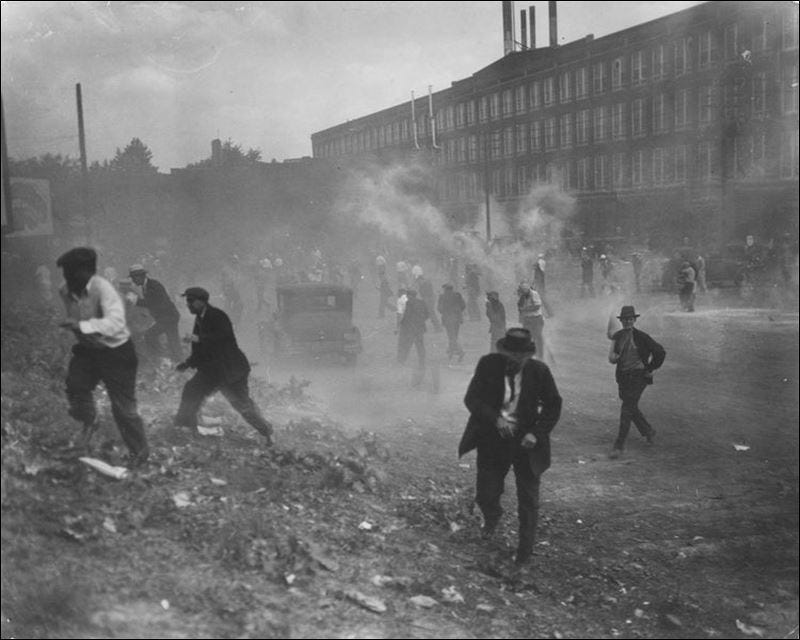
During the ‘34 work stoppages, especially with the Toledo auto parts workers and the Teamster truck drivers in Minnesota, the unions and outside organizers took great care to organize the unemployed which helped prevent scabbing and mobilized an untapped force of solidarity. With job insecurity currently skyrocketing, and union density currently nosediving, do you see a way where non-union, unemployed, or misclassified workers could be a galvanizing flank of social resistance?
I don’t think you’re going to get any struggles led by totally unorganized people, but there are different forms of organization. There were unionized workers present in each of those strikes in ‘34 at the center of them. Not in the sense of having union recognition, but rather deciding they were going to, say, join the ILWA on the west coast ports, or join the Teamster local in Minnesota, or they were going to join proto-UAW in Toledo. The Communist Party played a huge role in San Francisco. The Trotskyists played a huge role in Minneapolis. And there was a kind of an idiosyncratic socialist formation with A.J. Muste, who played a really important role in Toledo. It’s those groups that have an analysis of — and have a strong connection to — the mass movements of the unemployed. They had an analysis of the connection between the struggles of industrial workers and the struggles of the unemployed. As you said, there’s a question of the unemployed having to be organized to prevent strike breaking, but also, the unemployed as a source of bodies.
There are not hundreds of thousands of industrial workers in most of these cities. But there are tens of thousands of unemployed. And there’s a certain kind of militancy that kind of comes from that too. I think we can locate a helpful analogy from back in 2020: the kind of analysis of the Black Lives Matter struggle was a struggle against the carceral state, which, among other things, functions as a system for the punishment and discipline of the unemployed. So we have approximate historical experiences. They’re not identical to that experience of the 30s but I believe they can be helpful to think about in relation to that era.
As Trump continues tearing up collective bargaining agreements and cracks down on workers’ free speech, do you see an alternative where organized labor reciprocates that illegality with waves of unlawful strikes and just says, “come for us?”
I’m very reluctant to make guesses about this. There are elements within the left wing of the labor movements that rightly have assumed that we’re not going to have a smooth exit from the Trump era. Do we know exactly what that’s going to look like? No, of course not. But it’s very easy to imagine that within the dynamics around an election or judicial decision there could be an attempt to deploy major repressive power from above and it will be necessary to resort to the kind of tactics we’ve been talking about in this conversation to preserve even the kind of structure of liberal legality. There certainly are forces at work, like the May Day Strong movement and the effort to coordinate contracts for the 2028 general strike. This is an ongoing discussion happening in the labor movement. Although, it would have to go beyond the people who are actual members to succeed because that’s not a big enough group. They would have to figure out how to activate their ability to summon a wider section of society into the fight.
Is the general strike still the most effective weapon of leverage that workers have?
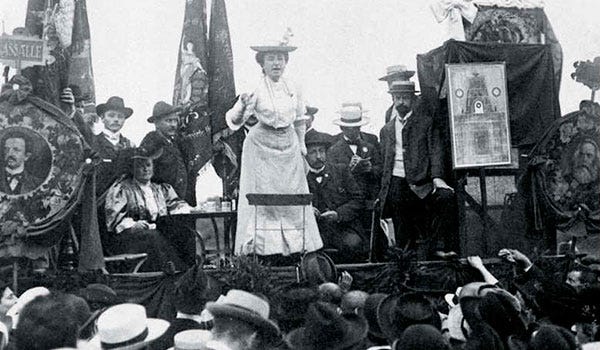
There’s a classic text in the Marxist tradition about general strikes, which is Rosa Luxemburg’s 1906 essay “The Mass Strike, the Political Party and the Trade Unions.” It’s a reflection on the experience of Russia in 1905 and the quasi-failed revolution. You know the Tsar nearly fell in the 1905 revolution as the prelude to 1917. And in that process, there were waves of general strikes playing out across the country. I just taught this text to my students last term actually, and we talked a lot about the metaphor that she uses throughout: she describes the mass strike as a storm. I think it’s certainly possible that we could have an experience that, while not exactly like 1905, has similar conditions that produce a type of mass workers’ mobilization: an economic crash, a disastrous war, low union density. So there are these obvious historical symmetries. And the ideological conflict will force us to ask the same questions: Will this be a liberal, restorationist program? A follow-the-law kind of mobilization? Or will this summon more revolutionary elements to succeed? And how will the forces of middle-class liberalism and the rule of law relate to that possibility? Will they be willing to embrace what that might mean for their own authority?
Before I let you go, I want to give you a final word on the debates about what actually constitutes a general strike.
I think we should basically see general strikes as experiments in the laboratory of the workers’ movement, and about how to build solidarity on a wider scale than is often done. It’s fine and good to talk about the definitions of them, but I think that, to go with Luxemburg, general strikes have to be understood as a living organism that don’t obey any formalistic rules. You know, the debate that happens on Twitter periodically where someone calls for a general strike boils down to so little of the workforce being organized. There were always elements of spontaneity intrinsic to the general strikes of the past, but it’s extremely difficult to get tens or hundreds of thousands of workers out on strike together by blowing a whistle and saying, “Okay, it’s go time, everyone.” Maybe it’s a bit contradictory, of course, but general strikes have to arise out of the accumulation of previous struggles. But it also has an element of surprise and transcendence. To Luxemburg’s point, it has its own logic.
And that’s bigger than anyone, any of us. Like she said, it’s the storm. Crucially the logic of the mass strike oscillates between economic and political demands, which I think is the other key piece, right? In Luxemburg’s context, she’s talking about living under an absolutist state where workers don’t have any political rights. There are ways in which the economic demands that workers have around wages and hours can turn into political demands around civil and political rights, but then those turn back into economic demands and so on. There’s a generative dynamic. It’s easy to imagine our version of that now. But we shouldn’t try to pin [the definition] to a board like a butterfly, that we know exactly what a mass strike can look like at every conjuncture. It can be workers’ most powerful weapon, but it shouldn’t be viewed as this one culminating moment that we’re always working toward, where it’s all over after you “win.” It’s better viewed as part of a living process.