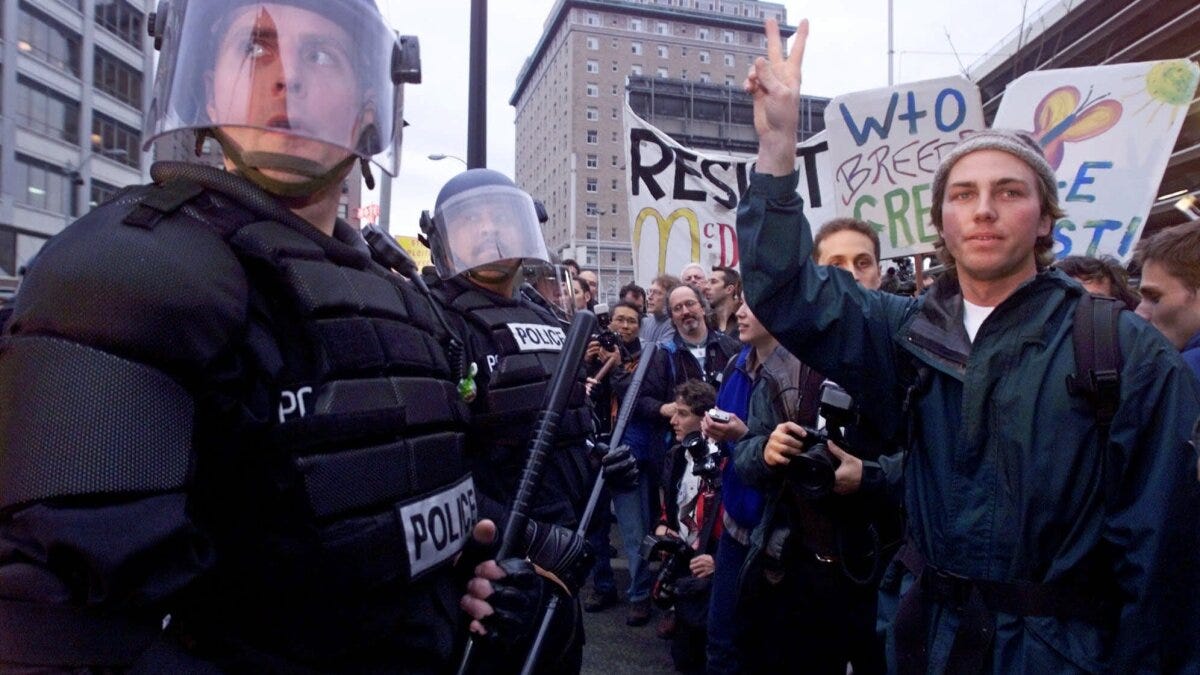

Twenty-seven years ago this November, nearly 50,000 protestors occupied the streets of downtown Seattle to shut down the ministerial conference of the World Trade Organization.
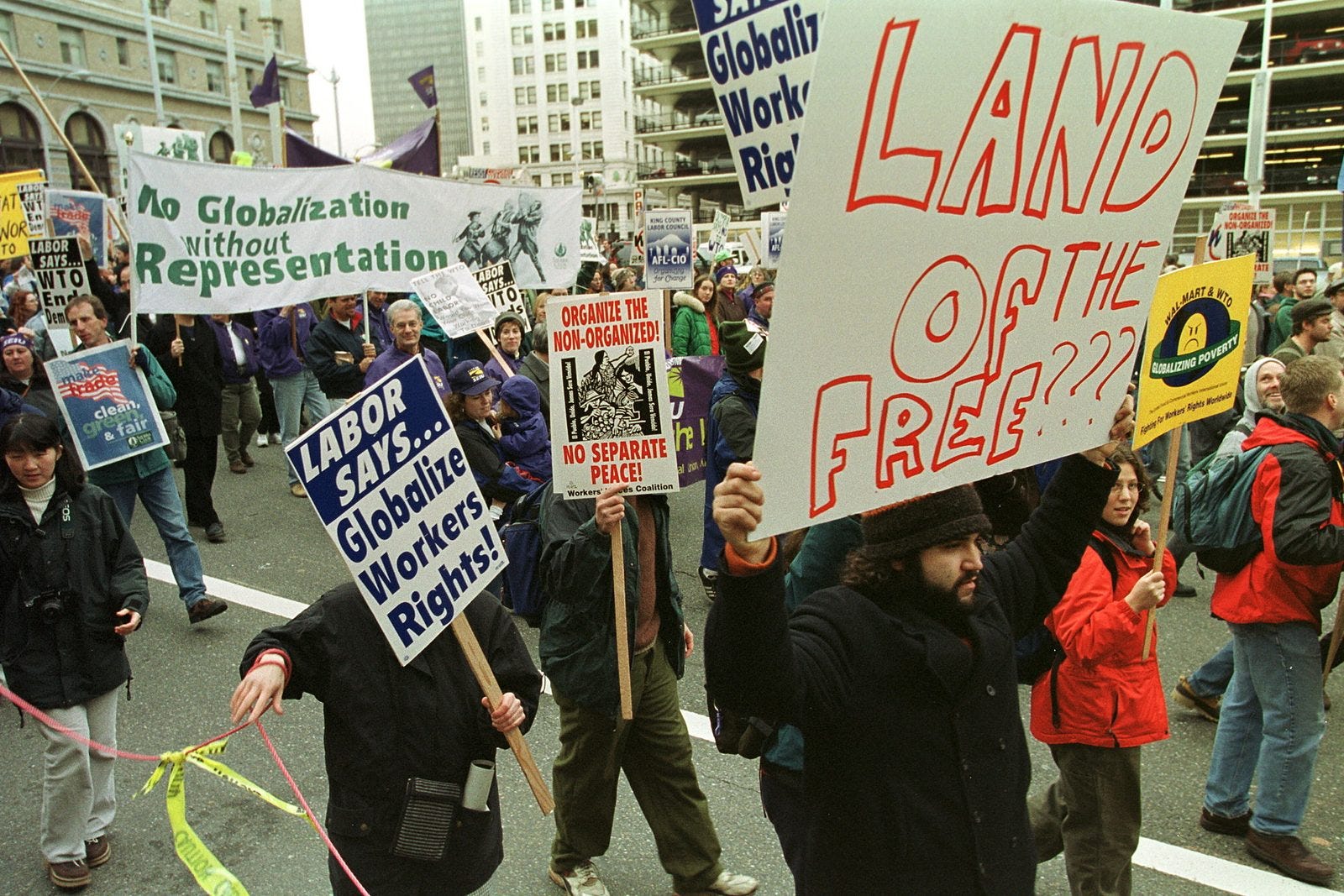
Environmental and indigenous rights groups, public educators, anti-capitalists, and labor unions ranging from the ILWU to the Teamsters came together to successfully disrupt the meeting where world leaders and corporate executives had convened to sign a suite of global trade agreements that this grassroots coalition rightfully interpreted as anti-democratic and harmful to workers both domestically and abroad.
President Bill Clinton’s invitation to host the WTO in Seattle, right on the heels of NAFTA’s passage and its devastating impacts on manufacturing jobs in this country (as well as on wages and collective bargaining power outside our borders) inspired a fierce, disciplined resistance against globalization efforts. If our economic, civil, and political rights were going to be subordinated to global business interests by an unelected corporate judicial body, then these protestors wanted to make sure the trade ministers present — and the politicians doing their bidding — would hear from them outside of the Seattle Convention Center.
The Seattle police department, completely unprepared for the size of the turnout, almost immediately responded to the peaceful demonstrations with militarized force. It’s the ensuing days of unrest — and the asymmetrical media narrative that begins to take shape against the protestors (sound familiar?) — that documentarian Ian Bell reconstructs and interrogates with striking clarity in his new film WTO/99.
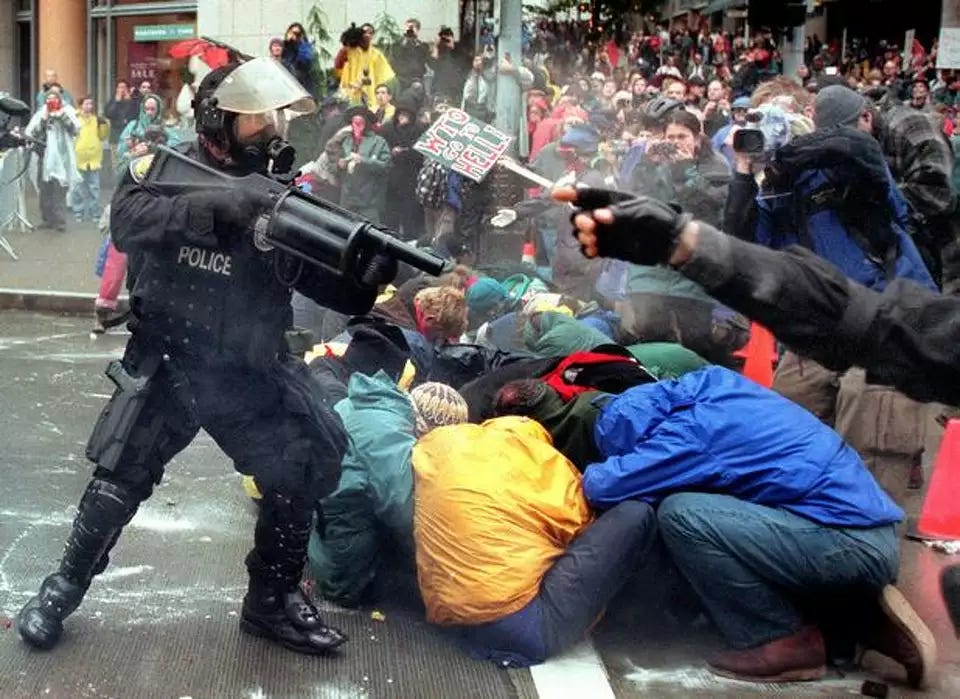
Pulling from a thousand hours of archival footage, Bell recreates a real time street-level view of the protestors’ clashes with the police and National Guard, using recorded materials from activists’ handheld miniDV camcorders, police recording devices, closed-circuit surveillance systems, and local media segments. The result is an essential historical document, one that captures the reality of organized resistance from below and the overwhelming forces (of police might, of a consent-manufacturing media, of capital) militating against them.
Director Ian Bell, a Seattle native, hopped on the phone with me to discuss the legacy of the WTO, the process of reassembling such a massive tranche of archival footage from the protests, and what the Battle of Seattle portended about our current political reality.
Do not miss this film when it comes to your city. Stay updated on upcoming screenings here.
Why did you want to revisit the WTO protests now, 27 years later?
It was two things. First the personal side of just being a local kid, born and raised in Seattle. My family’s been here for a few generations. But I wasn’t there for the demonstrations against the WTO ministerial conference. I happened to be living in Japan at the time and it’s just a weird thing to miss such a consequential political event in your hometown when you’re 19. I actually missed two years of American political history first person: I left Seattle two months before the WTO and got home roughly two months after 9/11. So it has stayed in the back of my mind.
And then there was narrative surrounding the legacy of the protests. I got a lot of stories and perspective from a cousin and some other dear friends that were down there protesting and engaging with everything on the streets. They had a very clear understanding of what the WTO was and how the police responded. But then I would talk to family and friends who only watched it via local news from their couches just a half-mile away from the events, and their perspective tended to be very different because they followed the narrative that the local news constructed. One of the things I really love about being able to do archival work on topics like this is you get to hear all these different perspectives, you get to read the essays and the op-eds, but then you watch 1,000 hours of footage of the event unfolding, and as much as the visual record can provide, you get to know the observable truth. Having the opportunity to go through this footage and resolve that dissonance between the narratives I was hearing from different people was a big draw for me.
WTO/99 attempts to recreate a sequential timeline of the four days of anti-globalization protests and the almost immediate police overreaction. A thousand hours of archival footage from so many different perspectives would seem impenetrable. How did you bore your way through?
We wanted to take this immense visual data set and go through it rigorously in hopes of reconstructing a firsthand perspective. It helped to zoom out. When [editor and producer Alex Megaro] and I were making the doc about the January 6th insurrection for Source Material on Vice News and trying to understanding these reactionary movements, we would talk a lot about how our political contemporary doesn’t come from just yesterday. It’s not something that just pops out of a box. There is context, and a history, and I had a sense that that history probably ran through Seattle. It seemed to me that we might understand the defection of the labor class from the Democratic party and it’s rising involvement in MAGA if we understood labor’s revolt against the WTO a bit better. You can draw a direct line to today’s battles from the environmental concerns, the human rights concerns, and the labor concerns of the 90s, because they were all concerns that were never really met by politicians beyond lip service. Midway through the editing process, it just became so clear how Democrat-aligned the political structure was at the time of the WTO protests. The Democratic Party represented every lever of power from the mayor of Seattle to the President of the United States and how clearly they were all ignoring the concerns of the base, specifically the concerns of labor. The political character of the labor movement began to reflect [that betrayal].
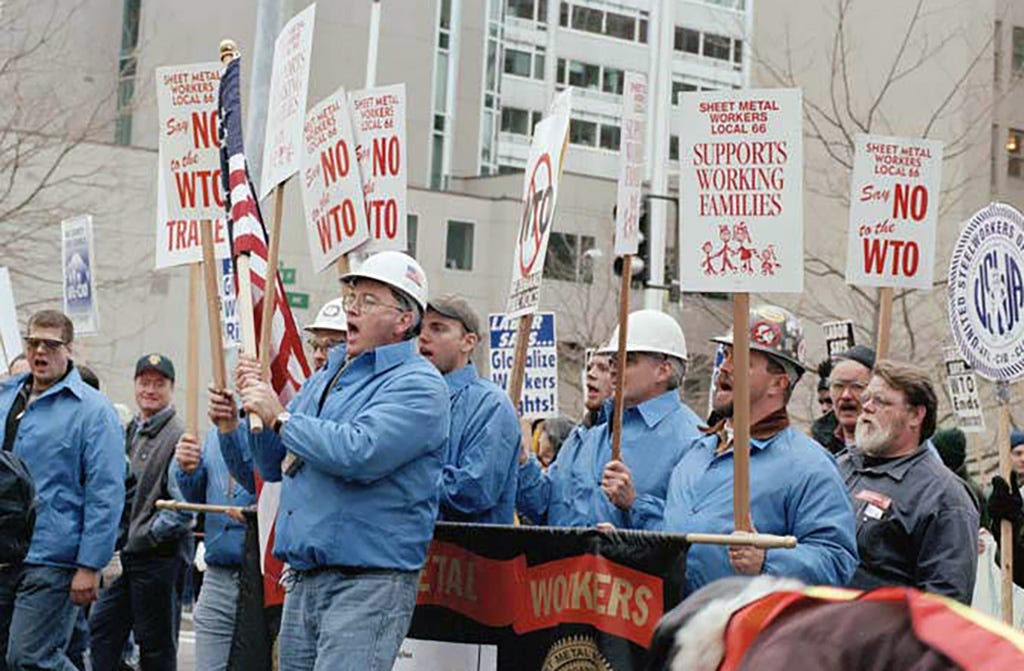
The WTO’s anti-democratic vision of the future — where unelected corporate power brokers produce trade agreements that prioritize shareholder value at the expense of worker, consumer, and environmental rights — inspired a diverse, seemingly contradictory coalition to mobilize against it. Anarchists and craft unions, The Church and Friends of the Earth, Pat Buchanan and Ralph Nader. Out of all the activist and social movements present, what was it about labor specifically that unlocked your understanding of the protests?
I’m not inside Democratic boardrooms but it felt like there was an active pushback against the idea that labor would ever leave the Democratic Party. Since the 2016 election there was such a denial that the party needed to change policy or change messaging, or that there was even a problem brewing. Bernie Sanders, during the primary, had such a clear message and clear intent about the way the party should orient towards the working class and American labor more generally. I’m not sure how to articulate it even clearer than that, but it just seemed the party had this apprehension to acknowledge that there might have been some missteps. As I say missteps, I recognize that’s a little too apologetic and forgiving. I’ll be direct: These were very intentional choices made by the Democratic Party. They were deliberate and mirrored the policies of both Reagan and Bush. It was a uniparty when it came to catering to corporate interests. The job losses, the shuttering of manufacturing, just the sheer idea that you couldn’t get a good-paying job doing what had been done for so much of the last century that created the middle class. It was just interesting to me that some of the people marching with their union [in this footage] might later be a critical voting bloc on behalf of the same exact forces that were legislating against their economic interests.
The archival footage you were able to source for the doc is truly staggering. The WTO protests are widely recognized as the birthplace of modern citizen journalism that predates camera phones and democratized social platforms. Can you talk about how you were able to get your hands on it?
There’s a local organization called MIPoPS, Moving Image Preservation of Puget Sound, which focuses on digitizing magnetic tape before the material becomes too degraded to read. They'd been working on a digitization project that included roughly 400 hours of footage from the WTO events that was shot by the Independent Media Center. The footage was going to then be housed by the University of Washington's Special Collections, where it can be found now. I first heard about the digitization project when they were about halfway through the process. I reached out to the library and asked if I could take a look once it was finished. The University also happen to house the archives of the local news outlets, which was really helpful. After we had access to what the UW was housing, our archival producer Debra McClutchy found another 600 hours. This included national and international media, as well as Seattle Police Department’s own footage and audio recordings. Along the way we were also finding additional tapes from locals who brought their cameras down to the protests that week. I should note that after finishing the film I joined the board of MIPoPS, to help with the work of preserving the pacific northwest's visual history.
Can you walk me through the timeline reconstruction process?
The goal was to make it as robust of a visual data set as possible. The idea was: can we get footage from every possible layer? Can we get it from the individual protesters? Can we get it from the active independent journalists at the protests? Can we get it from a local news reporter? Can we get it from national, international media? Can we get it from CCTV? So we just tried to find all the layers and build out from there. CCTV doesn’t editorialize. It’s often just static, so it provides a nice wide shot to give you a whole scene. But everything else from there is footage influenced by subjective choices being made by individuals. So, to me, the more of those layers you have, the more sources you have. This helps [minimize] the individual editorialization because you just get to see a more full-view of the thing that is happening.
Then once we started syncing everything up we were always trying to, to the best of our knowledge, adhere to the chronology. One of the great gifts of local news is they’ll often have the timecode burned in. Local news was running almost 12 hours a day during that week, so we kind of knew exactly when things were happening through their footage. Like, when the police start gassing protestors on the first day of protests on 6th and Union, I think we had 12 angles. And that’s all being cut in real time. That moment lasted roughly 12 minutes. In the final edit of the film, it’s about seven and a half minutes. So we do trim out some, but we’re not moving a shot. We didn’t set out to make it look like they were telling a produced version or some fabrication. But by comparing it and cutting it next to the footage that was happening in that same moment or just moments earlier, you’d get a really strong sense for the divergence between the local news narrative and what was unfolding on the streets.
WTO/99 is an essential historical document, but as a case-study in how easily consent is manufactured by local and national media it deserves to be regarded as a definitive model. One surreal moment shows a CNN anchor helping a business leader rehearse his anti-worker soundbite before going on air. That kind of stenography on behalf of police and business interests for viewers just watching at home stacks the deck against the activists’ reality on the ground.
We already had a sense that maybe the local news didn’t tell us what was actually going on, just listening to the stories I was hearing from friends and family before we started making it. At the very end of WTO/99 we see a local man giving comment during the Seattle city council hearing and he talks about how the powers that be don’t want us to believe our own eyes. The recorded image allows us to see things that we don’t have access to physically, which is a tool that power wants to manipulate to this day. Like the guy said in the film, a similar thing happened with Rodney King: they want us to deny our senses, that we’re supposed to believe that the physical world is not observable. One thing I really love about this form of all archival filmmaking is that we’re legitimately trying to reconstruct the day. We take a lot of effort by not having voiceover and not having editorializing text in order to remove ourselves as much as we can. One clip from one camera can be divorced of its context. But with the power of 1,000 clips from dozens of video cameras, each clip, each angle, all at different lengths and fleshed out, the power of those truths accumulate. They give each other their context back. I like treating the footage with respect and treating it as a historical artifact. The film gets to foster trust with the audience that we hope helps achieve a consensus reality. Otherwise it’s disorienting. And disorientation only benefits power.
Even after toiling with so much available footage, did you walk out of that edit bay wishing you were able to cover more?
You know, the film focuses so succinctly on those specific four days that we just didn’t have the footage that captured the sheer amount of planning that went into it, the amount of prep by all these organizations that mounted the defense. We looked for it. We sadly didn’t have visual resources at our disposal to recreate that component of the visual artifact. You see so much of the direct action on those streets that took a lot of work from a number of organizations and organizers. But what you don’t see is the actual organizing by that small handful that got together and worked for the better part of a year to get environmental groups, labor groups, and human rights groups to sit down together and mount a united front against the conference coming to their city. These are not organizations that are not often on the same page every day. And there’s a real effort that has to go in to helping people find common ground. Like one organizer says in the doc: this isn’t a left vs right battle, it’s the top vs. the bottom. So I wish the film could’ve shown you this incredibly precious unique gift that organizers have, a gift that we are so desperate for now.
This a newsletter about the history of general strikes so I would be remiss if I didn’t mention that the WTO protests transpired exactly 80 years after the Seattle General Strike of 1919, which was another historical flashpoint that rarely gets mentioned in history books. Seattle has such a rich labor history. Do you have any connection to the labor movement?
That’s funny you ask because I was just in Winnipeg screening the doc and so many people I talked to asked about the 1919 general strike in Seattle because they had a sister strike in Winnipeg at the same time. But yeah, just from my own personal connection to the labor movement, my uncle was in the ILWU Local 19 here at the Port of Seattle. My grandfather was a union typesetter at the Seattle Post-Intelligencer his whole career. My great-grandfather was sawyer who worked in the mill his whole life. He organized and was the president of the local 800 shingle weavers union. He was also a member and VP of the WA-OR district council for the United Brotherhood of Carpenters and Joiners Negotiating Board for the shingle industry. I’ve never not known the benefits of what labor has done for our society. Especially in the Seattle I grew up in, it wasn’t too hard to see the positive influence of labor.
What’s next for WTO/99? How can people seek this movie out?
Right now we are two-pronged. We’re still doing community screenings, so if there’s an organization that wants to show it to their community, they can reach out via our website and we’ll help them arrange the time and get them the materials needed. There’s a small fee, but that just really covers the time of logistics and prepping those materials. Then of course people can talk to their indie theater about showing it. It has worked in the past where we’ve had a few theaters just reach out to us because enough people said they want to see it there. Then we’re hoping by the end of summer we’re going to do a number of online screenings, into early fall as we gear up for the next political season. The goal is to make this available an easier for people to access it, maybe eventually a Blu-ray or physical print. But right now, we’re still in theaters and doing community screenings so check out WTO99doc.com where we announce upcoming screenings.